Why would I fire up a post on this topic right now? Yesterday, Warren Bird of Leadership Network, asked me to do a conference call with a group of seminary students at Alliance Theological Seminary. They are going through Church Unique as a text. The first question I got asked is, "How would you state the purpose of your book in one sentence?" In all honestly the question bugged me a bit, because I went through great pain to provide the clear answer to that in the introduction. It revealed to me the reality that most people don't connect their reading back to singular clear purpose, even when an author points it out clearly.
Here are the problems if you don't know the purpose of the book and the problem it solves:
- You might be wasting your time on a book and topic of no relevance to you
- You might not appreciate the difference between books that are well written and poorly written
- You might misinterpret what is being said through the content of the book
- You might apply a solution to a problem that was not the problem the book addresses
- You might not appreciate the problems that the author experienced before you do
Well this might sound a little to anal to you, but for me, its about being clear. There are more books out there that I could read in my lifetime, so its important for me to digest every book with intentionality. The two exceptions for me with non-fiction books are reading for entertainment or enjoying a biography for inspiration.
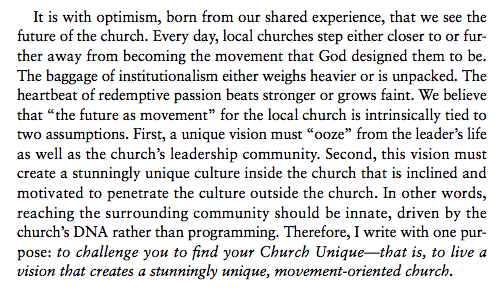
Just for fun, here is the singular reason I wrote Church Unique (seen in the excerpt below). It is to challenge the reader to find their Church Unique- that is, to live a vision that creates a stunningly unique, movement oriented church.
The problem that the book solves is unpacked in the first four chapters of the book (below) and reveals the problems and pitfalls of two decades of "visioning." The bottom line is that most work done under the banner of "visioning," in the local church is a waste of time. How's that for a problem statement?
- Unoriginal Sin - Neglecting Uniqueness
- The Fall of Strategic Planning - Obscuring the Essence
- The Iniquity of Church Growth - Caging the Kingdom
- Lost Congregations - How Churches Adapt to the Vision Vacuum
Here is the excerpt from the introduction: