
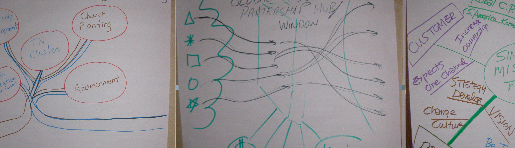
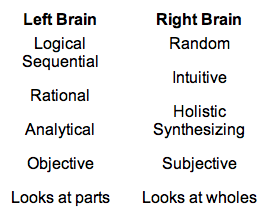
One of the greatest opportunities in helping people envision a better future is to ask them to draw pictures. One of the secrets of using pictures is that it unleashes a different part of the brain that leaders often DON'T use when planning or problem solving. The attributes of the right brain enable people to live in the conversation of possibilities in a non-threatening way. Imagine scenarios of looking at alternative ways to create, innovate, and structure. It's always healthy, always helps teams think better, and is often the key to solving a problem or seeing a preferred state.
Several weeks ago I was working with about 30 leaders who were facing obstacles to better team synergy due to their distributed and loosely affiliated network. To use the left side of the brain only would have been extremely difficult. But when we used drawings we saw similar patterns in radically different ways. Each drawing produced new insight and perspective. Again the beauty is that no drawing is "right or wrong."
So how do you actually accomplish a meaningful drawing exercise? There are no formulas, but here are some design considerations.
1) Have people divide into groups of 4-6 to work on common questions. Each group will produce their own unique pictures based on the exercise.
2) Don't be afraid to force the exercise with a time limit. Groups need a time limitation to collaborate and "push" together. It's common for me to have 20-45 minute time limits based on the complexity of the exercise.
3) Mix up competencies, perspectives and personalities as much as possible. If different functional teams are present, have them meet with colleagues from other departments.
4) Encourage creativity and provide different color markers. A little color goes a long way.
5) Consider using a "blank slate" and a question. If you do this you need to give a very precise question to answer. For example,, "If we were start our organization all over again today, how might we structure differently in light of the new "glocal" ministry environment?" Or "Given the fact that 70% of the unchurched population around us doesn't even care about church, how might we best bring the gospel to them?
6) Consider starting with a half-drawn picture. The part that you draw may be a larger framework, some organizational non-negotiable or some shared problem that can be represented as a partial picture. The exercise becomes the work of "completing the picture."
7) Keep it serious and fun. In my faith based work, prayer is an essential just before launching into the exercise. Ultimately we are trusting the power of the Holy Spirit to help us see God's better future together.