May 3, 2013

3 Kinds of Weak Vision that Entice Church Leaders

Warning: This post will challenge some of your assumptions about vision in the church.

Across the North American church landscape this year, many pastors will articulate a vision and compel people toward a preferred future that is weak. It’s very nature will be lacking in biblically rugged, God-saturated, deeply compelling content. Note that I said the vision will be weak; not bad and not wrong. What do I mean by this comment? The three kinds of weak vision I want to clarify are lacking potency because they are more of a means to an end that we often realize. Therefore they are missing the end-game, the bigger deal, the ultimate move. “Means” is not the meat of vision casting. For example, if General Electric wants to “Bring Good Things to Life,” they don’t show you the blueprint of the dishwasher.

Now a pastor may quickly assent to the fact that that the three kinds of vision are indeed means to a greater end. But afterwards he will practically and experientially guide his people with a lower aim.I have seen it hundreds of times. So what are the three kinds of weak vision?

  • A building is a weak vision. We intuitively get this. We know the building is a “tool” to accomplish the “bigger mission.” Yet, in the daily grind of raising money in our capital campaigns, its easy to appeal only to the consumeristic impulse of the congregation. A building is a means to something.
  • Going multisite is a weak vision. The move to multisite is the most relevant kind of weak vision today. The number of multisite churches is accelerating, and the average size of a multisite church is decreasing. It is safe to say that multisite is the new normal. And for good reasons. But ask a pastor about the vision driving the multisite, and you might be surprised how little they have to say. Multisite is a means to something.
  • More people in worship is a weak vision. The third one is connected to the first two. Indeed you may think it is the substance of the first two. We are building a building to what end? More people of course! We are going multi-site to what end? More people of course. Now don’t get me wrong. I think every church should be reaching more people and multiplying disciples. And more people, more building and more campuses are all important features of the vision. But by themselves they are weak. More people is a means to something.

Allow me to illustrate  a strong vision with my home church, Clear Creek Community Church in Houston. Our vision is what I call a “gospel saturation” vision. We have adopted a 500,000 population area that we refer to as the “4B” area. (From the beltway to the beach; from Brazoria county to the bay.) One of two people in this area are “nones;” that is they have no faith affiliation whatsoever. In the next 15 years, our vision is for each of the these 500,000 people to be one degree away, relationally speaking, from an invitation into a gospel-centered, missional community. With this summarized substance of the vision, we can now see how buildings, multisite campuses and more people are means to a full picture, high-definition vision.  We see the need for ten campuses and know that three campuses will anchor the ten with more significant buildings. But those pieces aren’t the purpose themselves. Why is it critical important to show buildings, multi-site and more people as means and not ends?

  • First, focusing on means unintentionally amplifies the self-promoting motives of church leadership. An ends-based vision, in contrast, connects the idea of “bigger” to the broader redemptive motives of God.
  • Second, highlighting the means only incurs emotional connection indirectly through the personal contact to and relationship with a church leader. In other words, I don’t get excited about a mean-based vision unless I am friends with he pastor who is casting it. Ends-based vision, on the other hand, accelerates emotional connection directly with the picture of the future, not the person talking about it.
  • Third, means-based vision is ultimately a church-centric idea. Therefore people let the “pastor and staff” be the owners of it. Ends-based vision, however, distributes the accomplishment of the vision to each one, every day in the congregation. The real vision must be a life-centric idea, not a church-centric one.

I know all this talk of “means” and “ends” sounds a little nerdy. (The engineer in me!) But I hope it connects you back to the simple leadership model of Jesus.

Want to read more about strong vision: Check out “The Church List for the Rest of Us.” It’s called the Unique 19 and it is 19 amazing stories of vision that are not based on church size.

April 19, 2013

Why Faith Wasn’t Meant to be Safe – Vince Antonucci’s Renegade Book ($0.99 Today Only)

Today I am recommending a book by one of our team members, Vince Antonucci: Renegade: Your Faith Isn’t Meant To Be Safe.

Here are some thoughts from Vince and a great story to give you a taste of Vince’s style and background.

It’s a book about this kind of life – the kind of life Jesus and Jackie Robinson inspire me to live. Today I’m a pastor near the Las Vegas strip, which is definitely out of the ordinary. I’m not sure I live at a higher level everyday, but I am trying.

My hope is that Renegade will help people connect with Jesus in a way that moves them toward extraordinary lives. I’m so eager to see this happen, I teamed up with my publisher to sell the ebook version for 99 cents from April 12-19 in honor of Jackie Robinson, who is celebrated in the newly released movie 42.

I hope you’ll pick it up, and if you do I’d love to hear what you think. You can email me here.

GREAT STORY – How Jackie Robinson Saved My Life

I grew up in a verbally abusive home. My father’s violent tirades were like heart-seeking missiles. And if my father, someone who was obligated to love me, couldn’t love me—if he couldn’t find anything special in me, I reasoned I must be defective.

I needed a place to escape, and I found it in baseball. I tell people baseball was my first love, and I mean it. From age six I was watching games on TV, memorizing statistics on the backs of baseball cards, playing out imaginary games with my glove and tennis ball in the backyard—all of this helped me escape my father… Read More

Vince Antonucci is the founder and lead pastor of Verve, an innovative church plant for the unchurched near the Las Vegas strip. Vince’s passion is creatively communicating biblical truth to help people find God. He blogs at www.vinceantonucci.com and speaks and coaches for Auxano.com. He is the author of I Became a Christian and All I Got Was This Lousy T-Shirt, Guerrilla Lovers, and Renegade. All three of his books are available in ebook form for 99 cents April 12-19, 2013.

April 17, 2013

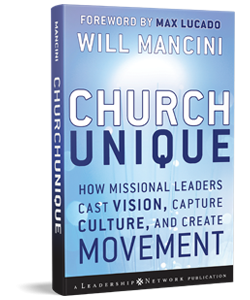
Free Resources & Latest News to Celebrate The 5th Anniversary of Church Unique

The MOST Important Chapter:  Chapter One – UNORIGINAL SIN

The BEST 12-pages from the Visual Summary : The VISION FRAME

The NEXT tool we are creating: The Unique 19 – “The Top Church List for the Rest of Us.”

Who made the list for 2013? Stay tuned…

The LATEST initiative we launched. CAMPAIGNS!

Yes, finally your next capital campaign can be truly vision driven from the inside out, not just “vision sugar coated.”  See why I hired Todd McMichen to lead this initiative.

My milestone post on Facebook today. Swing by and check out my NEW author page.

Five years after the publishing of Church Unique, I could not be more grateful to God.

The original idea was to write the playbook for a small tribe of churches who were really intentional about the missional reorientation and authentic discipleship but didn’t have a “go to” vision or planning process. My deepest desire was to free leaders from copying other church models and to design their own, based on their unique context and their unique calling.

But God used the book to expose the clarity and strategy vacuum that most churches in North America face. Today, Church Unique is being used as the recommended vision tool in a majority of denominations and church planting networks. It continues to fuel the work of our growing Auxano team and strategic partnerships with other resource providers in the church space. (like Ministry Grid and Visioneering Studios, a church architecture firm).

In the end, Church Unique would mean nothing, if it was not for the thousands of pastors who have passionately engaged the journey of discerning, developing and delivering an stunningly unique vision for the glory of Jesus. It’s all about what HE is doing in beautiful and powerful ways through YOUR church!

(The picture represents one of the thousands of church teams that have taken their church through the Church Unique Vision Pathway.)

April 5, 2013

7 Kinds of Stories Every Church Leader Should Master

All ministry is communication intensive. It follows that story-telling and understanding the nuances of story will help any leader in the daily ebb and flow of communication. Use these story types to do an inventory on your own “range” of utilizing of stories as a leader.

CREATION STORY

I am not referring to the first book of Scripture but to the genesis of the organization itself. If you are a pastor, you should know more about the creation story of your church than anyone on the planet. What are the circumstances—passions, problems, and people—surrounding how the church got started to begin with? Mastering the richness of the creation story will help in two major ways. First, it will hold insight into the unique culture of the church and therefore future decision-making and vision. Second, your mastery of the story itself will bring tremendous credibility with people when initiating change.

ACTION STEP: Write a one-page, 2-minute creation story talk. If you have any gaps in your knowledge interview people in your church until you know more than anyone else.

SIGNATURE STORY

A signature story relates to any milestones or hand-of-God moments after the creation story. Obviously a church with more history will have more signature stories. These accounts show off strengths of the church and God’s hand in it’s history. I look for signature stories when discerning a church’s Kingdom Concept (What can your church do better than 10,000 others). These stories reveal the values and mark the high-water line of God’s activity and unique journey for each church. Use the signature stories the same way as the creation story: celebrating God’s goodness, explaining decision-making and guiding change.

ACTION STEP: Make a list of 3-5 possible signatures stories in your church. Ask key leaders to do the same and make a master list of the top 5.

FOLKLORE

Folklore stories are simply ones that are worth being told and retold. While there may be overlap between the first two of the list, folklore often focuses on the life change journey of individuals. Even though everyone has special stories of God’s transforming work in their lives, folklore shows off, in brilliant detail, the mission or strategy, a value or life mark, from the church’s articulated DNA (Vision Frame). Folklore often embeds a moment of modeling—like repeated prayer, gospel conversation or invitation toward an unchurched friend—that reflects “the win” we are striving for as a congregation.  Imagine a church planter who sees a convert grow with unusual intentionality to become a key leader in the church. This story could model the pattern that we hope to see repeated over and over.

ACTION STEP: Identify 3 stories from individuals in your church that you know could never be shared too much. Ask another leader in your church to capture all of the details of the story in a 2-page, 5-minute summary.

HORIZON STORY

Now we turn our attention of story-telling to the future. Think of the horizon story as time-machine window where you tell people what God is going to do. It may have a lead in like, “What if…” or “Imagine…” Tell me a story of what the church will be like in one year. How about three years? When crafting this vision casting story, its important not to be presumptuous. To guard against that make sure you show what we call the “God smile,” that is, remind people that this is God’s idea not yours.

ACTION STEP: Prepare a 2-minute story to tell someone what your church will look like in one year. To give yourself freedom, don’t worry about sharing it with anyone— you may or may not. But practice thinking about the future feel of a story.

THE GOSPEL

The centerpiece of all story-telling is the Gospel. It is important to define every other story in relationship to the grand news of God’s intervention in our world and our lives through the death, burial and resurrection of Jesus. You may wonder, “This is a given, so why would you mention this as an organizational story.” First, I am surprised by how many congregations are stuck in a  shallow appreciation for the Gospel’s ongoing presence and power in daily life.  Second, as you master story as a leader, you won’t want to develop and practice the other story types to the neglect of the Gospel. Rather let the Gospel develop you as you integrate it into all story-telling.

ACTION STEP: Grab a copy of Center Church by Tim Keller and study the section on “Atonement Grammars.” This is one of the most helpful summaries I have ever seen.

TEACHABLE POINT OF VIEW

The last two kinds of stories have to do more with the personal life of the leader. A teachable point of view, a term coined by Noel Tichy in The Leadership Engine, is the story that surrounds a personal leadership learning. Informal leadership development happens best when an experienced leader, in relationship with other leaders can unpacks stories of why the do what they do. Where did this conviction come from? What led me to develop this skill? Why did I make what seemed to be a counter-intuitive decision? The more that you have thought about your leadership’s teachable point of views, the more often and intentional will be the transference of wisdom in your leadership culture.

ACTION STEP: Take 20 minutes and write down your top 10 learnings as a leader. Write down a few bullet points and begin to flesh out the story behind the learning.

CONVERSION STORY

The last story is the perhaps the most obvious, but I did not want it to go unstated. In my own leadership life, I have failed the most at rehearsing, in my leadership, the story of my own journey with God at its very beginning. Maybe that’s because it happened when I was in eighth grade. That seems pretty distant from the “important” leadership work of today. How many people on your leadership team know the details of how you trusted Jesus and how you grew in affection for the Gospel? Using your own conversation story as a leader is important for at least three reasons. First, it will keep you humble. Second, it’s a personal help to keep the Gospel at the center of all stories. Third, it will model for people the importance of sharing a personal testimony.

ACTION STEP: Create a one-page, 2-minute conversion story testimony. Practice sharing it with one person a week, asking the other person to share their conversion story.

March 19, 2013

Five Primary Sources of Distraction in Ministry

Yesterday’s post on “opportunity creep” introduced a common problem for pastors. It’s easy for opportunity after opportunity to press in and vie for the precious little time God has given you.

The first step to dealing with opportunity creep is to identify the sources of opportunities in way that repositions them as distractions. If we don’t understand that most opportunities are distractions in disguise, it will be hard to say “no” to the next seemingly “good” thing. See if these sources clarify the point:

Opportunity Becomes Distraction #1: The New is Askew

Who doesn’t love something new? Especially for us creative types its easy to feel the rush of the next. But the lure of the new can drive us to do too much at the same time, or too much to fast. The opportunistic personalities among us will look for the next ministry “find” before going deeper with what we already have. This week I was with a church that lamented, “Our people aren’t clear about who we are because we re-package ourselves every six months.” In short, make sure the next new thing is a deeply “you thing.”

Opportunity Becomes Distraction #2 Off-Mission Permission

In the desire for more ministry its easy to say “yes” to the ideas of well-meaning members. The problem is that most of their ministry aspirations are misdirected because they want to create more church structure and programming rather than living out their gifts and calling in life. The church very quickly becomes over-programmed and under-discipled.  The “more is more” default mode of program-permission clutters a simple discipleship experience in and through the church. Helping people dream big for Jesus is beautiful, overcomplicating church is not.

Opportunity Becomes Distraction #3: Funny Money

There is nothing more freeing than an abundance of resources, unless it comes with the proverbial attached string. Beware of that check-cutting, money-slinging individual—whether its a new member of an influential elder—that’s ready to fund the next thing (that they brought to the table.) If a new idea is connected to designated giving, always ask, “Would our vision really have taken us in this direction?” If people are not willing to subordinate their giving to the existing vision of the church, than it’s probably as distraction in disguise. (Sorry to break the bad news.)

Opportunity Becomes Distraction #4: Knowledge Trafficking

I enjoy learning as do most called into vocational ministry. But when our pursuit of knowledge outpaces our put-in-use of knowledge we’ll get used to living with distraction. To make matters worse, now you can get a direct feed of whatever-you-want-to-learn, whenever-you-want-to-learn through the fifty devises in your life. Don’t let your smart phone turn you into a not-so-smart leader. One of the greatest benefits of organizational and personal clarity, by the way, is the ability to ruthlessly filter out non-relevant new data.

Opportunity Becomes Distraction #5: Platform Jacking

The last source of distraction meddles a bit more than the others. Platform jacking is when we divert too time and energy to gaining influence through opportunities outside of direct day-to-day ministry responsibilities. There is certainly nothing wrong with wanting to “bless the capital ‘C’ church”— a noble aspiration for sure! Yet I am amazed at how quickly the favor of God on a pastor can back-fire on the mission of the ministry.  The success of the local church can become a “success distraction” for the pastor who spends increasing amounts of time growing his or her platform. Most of us have seen this in someone else, so just be discerning for yourself.